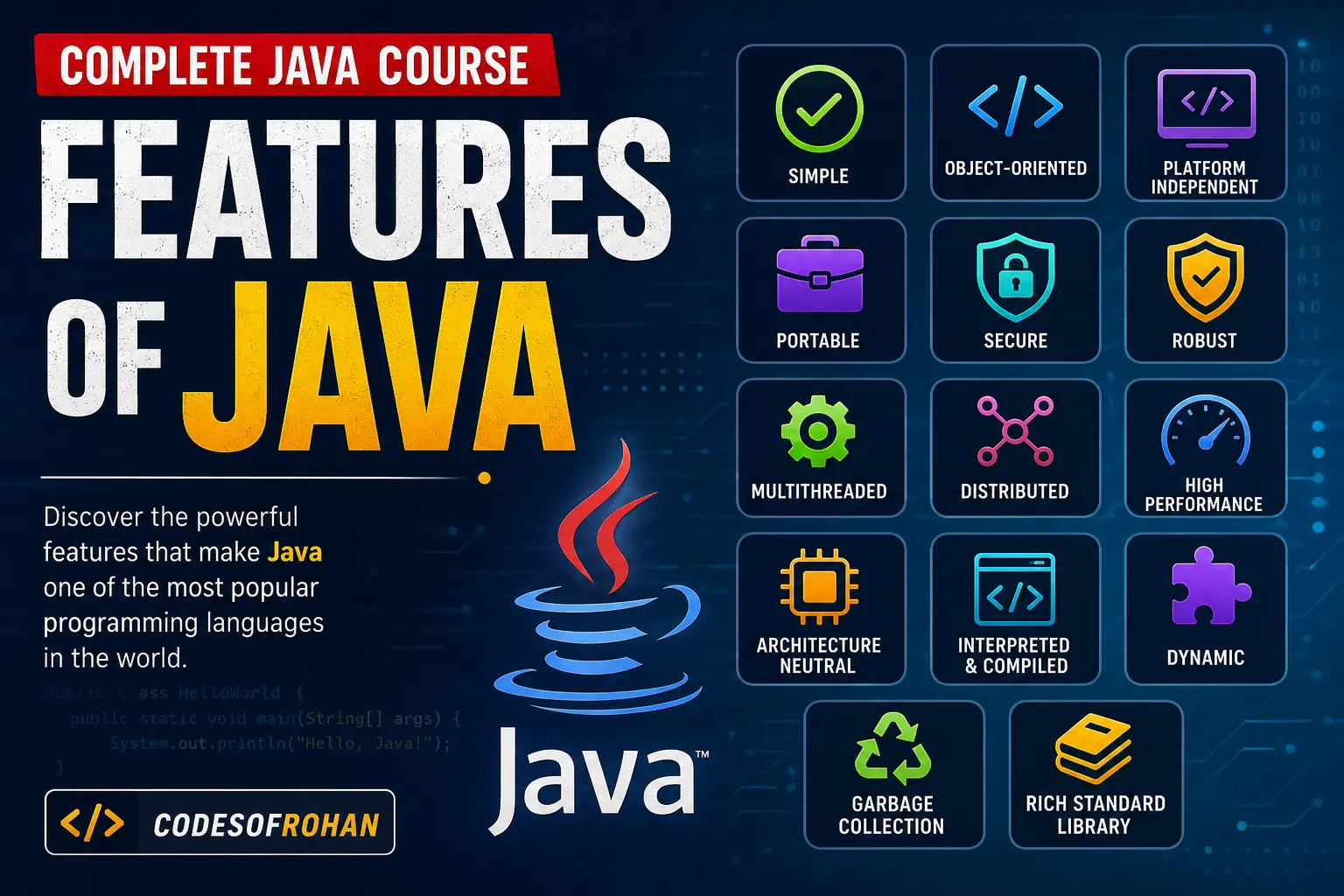
Hi everyone, at this point of time I believe that you should be curious about what java offers. Java is one of the most popular programming languages in the world because it provides many powerful features that make software development easier, faster, and more secure. These features are the main reason why Java is widely used in web applications, mobile applications, enterprise software, banking systems, desktop applications, cloud computing, and much more.
In this chapter, we will understand each feature of Java with simple explanations and real-life examples.
1. Simple
Java is designed to be simple and easy to learn. It removes many complicated features that were present in C and C++, such as pointers, multiple inheritance using classes, and manual memory management.
Java has a clean syntax, making it easier for beginners to read and write code.
Example
Instead of worrying about allocating and freeing memory manually, Java automatically manages memory using the Garbage Collector.
Benefit
- Easy to learn
- Easy to write code
- Easy to maintain programs
2. Object-Oriented
Java is a completely object-oriented programming language. Almost everything in Java is based on objects and classes.
The four main principles of Object-Oriented Programming (OOP) are:
- Encapsulation
- Inheritance
- Polymorphism
- Abstraction
These concepts help developers write reusable, organized, and maintainable code.
Real-Life Example
Think of a car.
The Car is a class.
Every individual car like BMW, Audi, or Tesla is an object created from that class.
3. Platform Independent
One of Java's biggest strengths is that it is Platform Independent.
A Java program can run on Windows, Linux, macOS, or any operating system without changing the source code.
This is possible because Java code is converted into Bytecode, which is executed by the Java Virtual Machine (JVM).
This concept is known as:
Write Once, Run Anywhere (WORA).
Example
If you compile your Java program on Windows, you can run the same compiled file on Linux or macOS as long as Java is installed.
4. Portable
Java programs are highly portable.
Since Java uses standard data types and Bytecode, the program behaves the same on different operating systems and hardware architectures.
This makes Java applications easy to move from one system to another.
Example
A Java application developed on a Windows laptop can be copied and executed on a Linux server without modifying the code.
5. Secure
Security is one of Java's strongest features.
Java provides multiple security mechanisms to protect applications from malicious code.
Some security features include:
- No direct pointer access
- Bytecode verification
- Class Loader
- Security Manager (legacy in older Java security architecture)
- Runtime permission checks
- Exception handling
Because of these features, Java is widely used in banking, financial systems, enterprise applications, and government software.
6. Robust
Robust means strong and reliable.
Java is designed to reduce errors and prevent program crashes.
It achieves this through:
- Automatic memory management
- Strong type checking
- Exception handling
- Garbage Collection
These features help developers build stable applications.
Example
If an unexpected error occurs, Java can handle it using exceptions instead of immediately crashing the entire application.
7. Multithreaded
Java supports Multithreading, which allows multiple tasks to run simultaneously within the same program.
Instead of executing one task after another, Java can perform several tasks at the same time.
Real-Life Example
Imagine using a music app.
- Music keeps playing.
- You browse songs.
- You download another song.
All these tasks happen simultaneously because of multithreading.
Benefits
- Better performance
- Faster execution
- Efficient use of CPU resources
8. Distributed
Java is designed for distributed computing.
This means Java programs can communicate with other programs running on different computers over a network.
Java provides APIs for:
- Networking
- Remote Method Invocation (RMI)
- Web Services
- Socket Programming
Distributed applications are commonly used in enterprise software and cloud computing.
9. High Performance
Java is generally faster than many interpreted languages because it uses the Just-In-Time (JIT) Compiler.
Instead of interpreting Bytecode line by line every time, the JIT Compiler converts frequently used Bytecode into native machine code.
This significantly improves execution speed.
Although Java may not always be as fast as languages like C or C++, it offers excellent performance for most real-world applications.
10. Architecture Neutral
Java Bytecode is independent of the computer's processor architecture.
Whether your system uses Intel, AMD, or ARM processors, the same Bytecode can run without modification.
The JVM converts Bytecode into machine code suitable for the underlying hardware.
11. Interpreted and Compiled
Java uses both a compiler and an interpreter.
Step 1
The Java Compiler (javac) converts source code (.java) into Bytecode (.class).
Step 2
The JVM interprets the Bytecode.
Step 3
The JIT Compiler converts frequently executed Bytecode into native machine code for faster execution.
This combination provides both portability and high performance.
12. Dynamic
Java is considered dynamic because classes can be loaded during runtime whenever they are needed.
This feature allows developers to:
- Load classes dynamically
- Update applications more easily
- Use reflection
- Build flexible software
Dynamic loading makes Java suitable for large enterprise applications.
13. Automatic Garbage Collection
Memory management is handled automatically in Java.
When an object is no longer being used, the Garbage Collector (GC) automatically frees the memory.
Developers do not need to manually release memory, reducing the chances of memory leaks and crashes.
Example
Suppose you create an object inside a method.
After the method finishes and no reference to that object exists, Java automatically removes it from memory when required.
14. Rich Standard Library
Java comes with a huge collection of built-in libraries.
These libraries help developers build applications without writing everything from scratch.
Some commonly used packages are:
- java.lang
- java.util
- java.io
- java.net
- java.sql
- java.time
These libraries provide functionality for collections, networking, file handling, database connectivity, date and time, and much more.
Summary
Java has become one of the most trusted programming languages because of its powerful features. It is simple, secure, portable, platform independent, object-oriented, robust, multithreaded, and high-performing. Features like automatic memory management, the JVM, and the JIT Compiler make Java suitable for everything from small desktop applications to large-scale enterprise systems.
Understanding these features helps you appreciate why Java has remained one of the most popular programming languages for decades and why it continues to be widely used in modern software development.
Key Points to Remember
- Java is simple and beginner-friendly.
- Java follows Object-Oriented Programming (OOP).
- Java follows Write Once, Run Anywhere (WORA).
- Java programs run on the JVM.
- Java is secure and robust.
- Java supports multithreading.
- Java provides automatic Garbage Collection.
- Java uses the JIT Compiler for better performance.
- Java is architecture neutral and portable.
- Java includes a rich standard library for faster development.