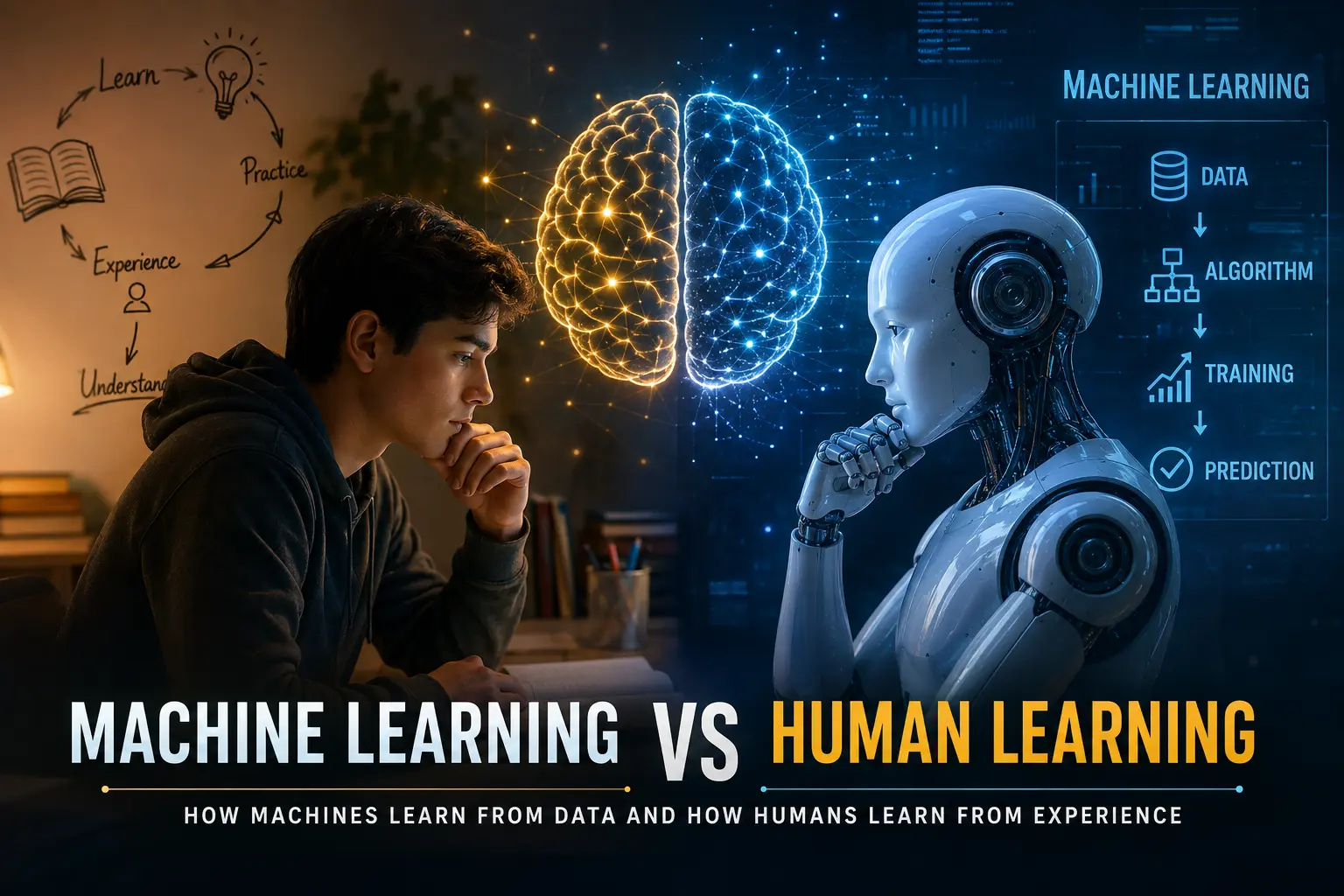
Artificial Intelligence (AI) is often described as the science of making machines intelligent. But when we try to understand one of the most important parts of AI—Machine Learning (ML)—a simple question comes to mind: How can a machine learn when it does not have a human brain?
The answer becomes easier to understand when we compare machine learning with something we experience every day: human learning.
A child learns to recognize a dog after seeing many dogs. A student learns mathematics by studying examples and practicing problems. A person learns to identify a dangerous road after experiencing or observing risky situations.
Machine Learning follows a somewhat similar idea. Instead of learning from life experiences, a machine learning model learns from data, examples, patterns, and feedback.
However, machine learning and human learning are not the same. Machines can process enormous amounts of data and find patterns very quickly, while humans can understand context, emotions, common sense, and experiences in ways that today's AI systems generally cannot.
What Is Machine Learning?
Machine Learning is a subfield of Artificial Intelligence that allows computers to learn patterns from data and use those patterns to make predictions, classifications, or decisions without being explicitly programmed for every individual situation.
In traditional programming, we generally provide a computer with rules and data:
Rules + Data → Output
For example, suppose we want to create a program that determines whether a number is even or odd. We can explicitly write a rule:
If number % 2 == 0
    Number is even
Else
    Number is odd
The programmer has already defined the logic.
Machine Learning works differently in many cases. We can provide a model with examples:
2 → Even
4 → Even
7 → Odd
9 → Odd
12 → Even
The machine learning algorithm analyzes these examples and learns a pattern that can be used on new data.
This is where the word learning becomes important.
The machine is not learning exactly like a human. Instead, mathematical algorithms adjust internal parameters based on data so that the model becomes better at performing a particular task.
How Do Humans Learn?
Human learning begins from our interaction with the world.
Imagine a child seeing an apple for the first time. Someone may say:
"This is an apple."
The child may then see apples with different colors, shapes, and sizes.
Over time, the child develops an internal understanding of what an apple generally looks like.
Human learning can involve several things:
-
Observation
-
Experience
-
Practice
-
Memory
-
Feedback
-
Reasoning
-
Emotions
-
Language
-
Social interaction
-
Previous knowledge
-
Common sense
Importantly, humans can often learn from relatively few examples.
A child may not need to see thousands of different cats to understand what a cat is. A few examples, combined with language and other experiences, may be enough to build a useful concept.
Machine learning often requires significantly more data, depending on the task and algorithm.
How Does a Machine Learn?
A machine learning system generally follows a process involving data, algorithms, training, and evaluation.
Consider an email spam detection system.
We can provide the system with thousands of emails labeled:
Email 1 → Spam
Email 2 → Not Spam
Email 3 → Spam
Email 4 → Not Spam
The machine learning algorithm analyzes characteristics of these emails and tries to identify patterns associated with spam.
During training, the model makes predictions and compares them with the expected results. The model then adjusts its internal parameters to reduce its errors.
After sufficient training, we can give it a completely new email:
New Email → ?
The trained model predicts whether the email is likely to be spam.
This process is fundamentally different from simply writing a rule such as:
If email contains "FREE MONEY"
    Spam
because real-world data is much more complicated than a small collection of manually written rules.
Machine Learning and Human Learning: The Similarity
Although machines and humans learn very differently, there are some interesting similarities.
1. Both Learn From Examples
Humans learn by observing examples.
For instance, when learning to drive, a person may first observe someone driving and then practice driving themselves.
Similarly, many machine learning models learn patterns from examples in datasets.
For example:
Image → Dog
Image → Cat
Image → Dog
Image → Cat
After training on many examples, the model can attempt to classify a new image.
2. Both Improve With Feedback
Feedback is extremely important for human learning.
Suppose a student solves a mathematics problem incorrectly. A teacher explains the mistake. The student learns from that feedback and hopefully avoids the same mistake in the future.
Machine learning also uses feedback during training.
If a model predicts the wrong answer, an optimization process can adjust its parameters so that future predictions become more accurate.
In supervised learning, the expected answer is provided as part of the training data.
3. Both Can Recognize Patterns
Pattern recognition is one of the most important abilities involved in learning.
Humans recognize patterns in:
-
Language
-
Faces
-
Sounds
-
Traffic
-
Weather
-
Mathematics
-
Social behavior
Machine learning models are also particularly good at finding patterns in large datasets.
For example, a trained model can identify statistical patterns in thousands or millions of medical images, financial transactions, or customer interactions.
Major Differences Between Machine Learning and Human Learning
Despite these similarities, there are fundamental differences between the two.
1. Source of Learning
Humans learn from the physical and social world.
A human can learn by seeing, hearing, touching, communicating, experimenting, and experiencing consequences.
Machine learning systems primarily learn from data provided to them.
If important information is missing from the training data, the model may struggle with situations that humans could handle using general knowledge or reasoning.
2. Amount of Data Required
Humans can often learn concepts from a small number of examples.
For example, after seeing a few examples of bicycles, a child can usually recognize other bicycles.
Many machine learning systems require large amounts of training data to achieve high performance, particularly in complex tasks such as image recognition or natural language processing.
This is one reason why collecting and preparing high-quality datasets is such an important part of modern AI development.
3. Speed of Processing
Machines have a major advantage when it comes to processing large quantities of information.
A machine learning system can analyze millions of records much faster than a human could manually examine them.
For example, a financial institution can use machine learning to analyze enormous numbers of transactions and identify unusual patterns.
Humans cannot compete with computers in terms of raw data-processing speed.
4. Human Common Sense
Humans possess a broad understanding of the world developed through years of experience.
Suppose someone says:
"The glass fell from the table and broke."
A human immediately understands that gravity caused the glass to fall and that the impact may have broken it.
A machine learning model does not necessarily understand the situation in the same human sense. It may have learned statistical relationships from huge amounts of text or other data, but that does not mean it possesses human-like understanding of the physical world.
5. Emotions and Motivation
Humans can learn because of emotions, curiosity, fear, happiness, ambition, and personal goals.
A student might study harder because they want to achieve a particular career goal.
A machine learning model does not have personal ambitions or emotions.
It optimizes according to mathematical objectives defined by its design and training process.
6. Generalization
Humans are remarkably good at applying knowledge from one situation to another.
Suppose you learn that touching a hot pan can hurt you. You can apply that understanding to many different hot objects.
Machine learning models can generalize to new data, but their ability to do so depends heavily on the training process, data distribution, model architecture, and task.
A model can sometimes perform extremely well on familiar patterns while struggling when it encounters situations significantly different from its training data.
A Simple Real-World Example
Consider learning to identify a fruit as an apple.
Human Learning
A child may:
-
See an apple.
-
Touch it.
-
Smell it.
-
Taste it.
-
Hear someone call it an apple.
-
See apples of different colors and sizes.
-
Compare apples with oranges and other fruits.
-
Eventually develop a concept of an apple.
The learning process combines multiple senses, language, experience, and knowledge.
Machine Learning
A computer vision model may receive thousands of labeled images:
Image 1 → Apple
Image 2 → Apple
Image 3 → Orange
Image 4 → Banana
...
The model analyzes numerical representations of the images and learns patterns that help distinguish different categories.
When a new image is provided, it produces a prediction.
The result may be similar—"This is an apple"—but the process behind the result is fundamentally different.
Why Is Machine Learning Important in AI?
Machine Learning has become one of the most important technologies within Artificial Intelligence because manually programming rules for every possible situation is extremely difficult.
Consider a self-driving vehicle.
It would be nearly impossible for programmers to write a separate rule for every possible combination of:
-
Weather
-
Road conditions
-
Vehicles
-
Pedestrians
-
Traffic signals
-
Road signs
-
Construction
-
Lighting
-
Unexpected events
Machine learning can help systems learn patterns from large datasets and sensor information.
Similarly, ML is used in areas such as:
-
Recommendation systems
-
Fraud detection
-
Speech recognition
-
Image recognition
-
Search engines
-
Medical analysis
-
Predictive maintenance
-
Customer personalization
-
Natural language processing
Machine Learning therefore provides an important way for AI systems to deal with complex real-world data.
Does Machine Learning Really Think Like a Human?
No.
The word "learning" can sometimes create the impression that a machine learning model learns exactly like a human.
It does not.
A machine learning model generally performs mathematical computations on data and adjusts parameters during training to minimize errors or optimize a defined objective.
Humans, on the other hand, learn through a combination of biological processes, experiences, memory, reasoning, perception, emotions, social interaction, and many other factors.
The similarity is mainly at a high level:
Experience/Data → Pattern Learning → Better Performance
But the underlying mechanisms are very different.
Machine Learning vs Human Learning at a Glance
| Aspect | Human Learning | Machine Learning |
|---|---|---|
| Learning source | Experiences, senses, education, interaction | Data and training examples |
| Processing | Biological brain | Algorithms and computing hardware |
| Data requirement | Often relatively few examples | Often large datasets |
| Speed | Comparatively slower at huge calculations | Extremely fast at large-scale computation |
| Emotions | Present | Not inherently present |
| Common sense | Broad and naturally developed | Limited and task-dependent |
| Memory | Biological memory | Model parameters and external data |
| Adaptability | Highly flexible | Depends on design and training |
| Feedback | Teachers, experiences, consequences | Training signals and optimization |
| Energy efficiency | Extremely efficient brain | Can require significant computing resources |
| Goals | Can create personal goals | Follows defined objectives |
| Learning environment | Real-world interaction | Training data, simulations, sensors, or interactions |
The Future: Combining Human Intelligence and Machine Learning
The goal of Artificial Intelligence does not necessarily have to be about replacing human learning or human intelligence.
One of the most useful possibilities is combining the strengths of humans and machines.
Humans are good at creativity, reasoning across unfamiliar situations, understanding social context, making value-based decisions, and using common sense.
Machines are good at processing huge datasets, detecting statistical patterns, performing repetitive calculations, and operating continuously at high speed.
Together, they can solve problems more effectively than either one working alone in many situations.
For example, in healthcare, machine learning can help identify patterns in medical images or patient data, while doctors can combine those results with clinical experience, patient history, and human judgment.
This is an important idea behind modern AI: machines can augment human capabilities rather than simply imitate humans.
Conclusion
Machine Learning is a powerful branch of Artificial Intelligence that allows computers to learn patterns from data and improve their performance on specific tasks.
The concept becomes easier to understand when compared with human learning. Both humans and machines can learn from examples, recognize patterns, and improve through feedback. However, the similarities largely stop at this high level.
Humans learn through rich real-world experiences involving perception, emotions, reasoning, memory, language, social interaction, and common sense. Machine learning systems learn mathematical patterns from data through algorithms and optimization.
Machines can process enormous amounts of information at remarkable speeds, while humans remain far more flexible in understanding unfamiliar situations and applying knowledge across different contexts.
Therefore, Machine Learning should not be thought of as a digital version of the human brain. It is better understood as a collection of computational techniques that allow machines to identify patterns and make useful predictions or decisions from data.
Understanding this difference is essential for understanding Artificial Intelligence itself. AI may sometimes appear to "learn" like a human, but behind that apparent intelligence lies a fundamentally different process—one based on data, algorithms, mathematics, computation, and patterns.