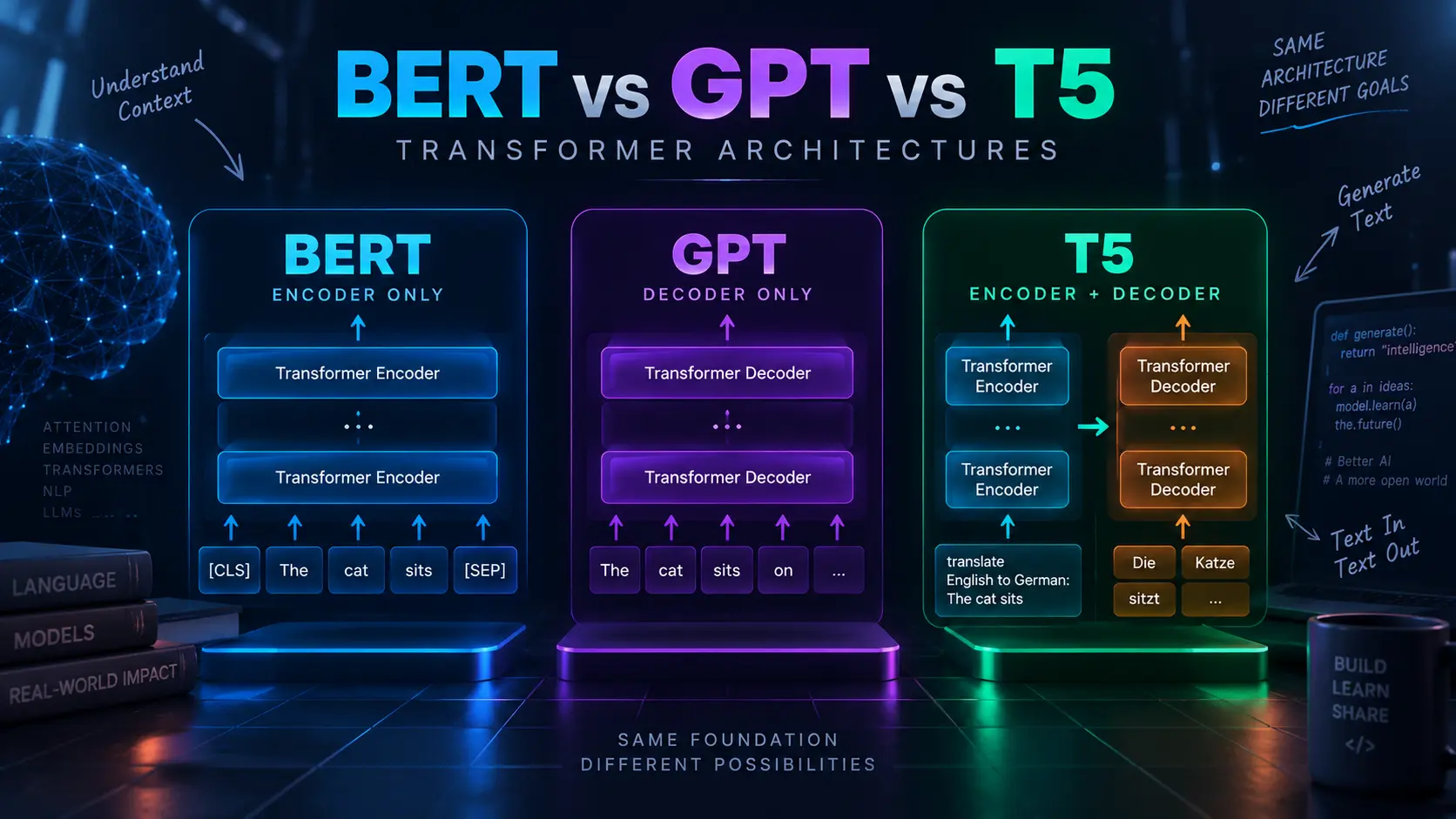
If you've been learning about modern AI, you've probably come across names like BERT, GPT, and T5.
All three are based on the Transformer architecture, but they don't use the Transformer in exactly the same way.
And this is where things can get confusing.
Why is BERT called an encoder-only model?
Why is GPT called a decoder-only model?
And why does T5 use both an encoder and a decoder?
The easiest way to remember the difference is:
BERT reads and understands text. GPT generates text. T5 reads text and generates text.
Of course, that's a simplified explanation, but it gives us a good starting point.
BERT is primarily designed to understand relationships between words and sentences. GPT is designed to generate the next token based on previous tokens. T5 takes an input sequence, processes it with an encoder, and then generates an output sequence using a decoder.
Let's understand why these models are structured differently and what actually happens inside their architectures.
The Big Picture: Encoder vs Decoder
Before discussing BERT, GPT, and T5 individually, let's understand the three Transformer configurations.
Encoder-Only
Input Text
    ↓
Transformer Encoder
    ↓
Understanding / Representation
    ↓
Output
This is the approach used by BERT.
The model receives text and creates rich representations of that text. This makes encoder-only models particularly useful for tasks such as classification, sentiment analysis, and extracting information from text.
Decoder-Only
Previous Tokens
      ↓
Transformer Decoder
      ↓
Next Token
      ↓
Next Token
      ↓
Next Token
This is the approach used by GPT.
The model generates text one token at a time.
For example:
The capital of France is
The model predicts something like:
Paris
Then it can use the expanded sequence to predict what comes next.
Encoder-Decoder
Input Text
    ↓
Encoder
    ↓
Encoded Representation
    ↓
Decoder
    ↓
Output Text
This is the approach used by T5.
The encoder understands the input, while the decoder generates the output.
This architecture is particularly useful when the input and output are both sequences of text, such as translation or summarization.
What Is a Transformer in the First Place?
To understand these architectures, we need to briefly understand the Transformer.
The Transformer was introduced in the famous 2017 research paper “Attention Is All You Need.”
One of its most important ideas is self-attention.
Imagine the sentence:
"Rohan went to the bank because he needed some cash."
When processing the word "bank", the model needs to understand what that word means in this particular context.
Is it a financial institution?
Or is it the side of a river?
The surrounding words provide clues.
The self-attention mechanism allows a Transformer to examine relationships between tokens in a sequence.
Instead of simply processing words independently, the model can determine which other tokens are important when representing a particular token.
This ability to understand relationships between tokens is one of the major reasons Transformers became so successful in natural language processing.
BERT: The Encoder-Only Transformer
Let's start with BERT.
BERT stands for:
Bidirectional Encoder Representations from Transformers
The important word here is Encoder.
BERT uses the encoder part of the original Transformer architecture.
The basic flow looks like this:
Input Sentence
      ↓
Tokenization
      ↓
Token Embeddings
      ↓
Transformer Encoder Layers
      ↓
Contextual Representations
      ↓
Task-Specific Output
The key characteristic of BERT is that it can look at context from both directions when building representations.
For example:
The animal did not cross the road because it was too tired.
To understand what "it" refers to, the model benefits from considering the surrounding context.
BERT's bidirectional representation learning was one of its important contributions.
How Does BERT Learn?
One of BERT's original pre-training objectives was Masked Language Modeling.
Imagine we have:
The cat is sitting on the mat.
Some tokens can be hidden:
The cat is [MASK] on the mat.
BERT tries to predict the missing word based on the surrounding context.
Because BERT processes the input bidirectionally, it can use information from both sides of the masked position.
For example:
The cat is [MASK] on the mat.
          ↑
       sitting
The surrounding words help the model determine that "sitting" is a likely prediction.
This type of training helps BERT learn contextual representations.
What Is BERT Good At?
Because BERT is designed primarily for understanding input text, it works well for tasks such as:
-
Sentiment analysis
-
Text classification
-
Named entity recognition
-
Question answering
-
Information extraction
-
Search relevance
-
Text similarity
Imagine an e-commerce website.
A customer searches:
"wireless headphones under 5000"
A language understanding model can help determine what the user is looking for and identify important concepts such as:
Product: wireless headphones
Price constraint: 5000
That's an example of where an encoder-style model can be useful.
The important point is that BERT isn't primarily designed to write long pieces of text from scratch.
It is designed to understand and represent text.
GPT: The Decoder-Only Transformer
Now let's move to GPT.
GPT stands for:
Generative Pre-trained Transformer
Unlike BERT, GPT uses the decoder side of the Transformer architecture, in a decoder-only configuration.
The basic idea is:
Input Tokens
     ↓
Decoder Blocks
     ↓
Predict Next Token
     ↓
Add Token
     ↓
Predict Next Token
     ↓
...
Suppose we give GPT:
Java is a
The model might predict:
programming
Now the sequence becomes:
Java is a programming
The model predicts another token.
Perhaps:
language
Now:
Java is a programming language
And the process continues.
This is called autoregressive generation.
The Important Role of Causal Attention
There is one major difference between the way GPT-style models use self-attention and the way BERT uses it.
GPT uses a causal mask.
Why?
Because when predicting the next token, the model shouldn't be allowed to look at future tokens that haven't been generated yet.
Imagine the complete sentence is:
The car is parked outside.
If the model is predicting:
The car is
it should not be able to look ahead and see:
parked outside
during that prediction.
Instead, it only has access to the tokens that have already appeared.
Conceptually:
The      → can see itself
car      → can see The + car
is       → can see The + car + is
parked   → can see previous tokens
This creates the autoregressive behavior that makes GPT-style text generation possible.
What Is GPT Good At?
Because GPT is designed for generation, it can be used for tasks such as:
-
Text generation
-
Question answering
-
Code generation
-
Summarization
-
Creative writing
-
Conversational AI
-
Explanation and reasoning tasks
Imagine you're using an AI coding assistant.
You type:
Write a Java method to reverse a string.
The model generates the response token by token.
That's a natural use case for a decoder-only architecture.
BERT vs GPT: A Simple Real-World Analogy
Think about a teacher checking a paragraph.
BERT is like a teacher reading the entire paragraph to understand it.
The teacher can look at the words before and after a particular word to understand its meaning.
GPT is like a writer creating the paragraph one word at a time.
The writer has already written:
Artificial intelligence is
and now needs to decide what comes next.
So:
BERT → Understanding
GPT  → Generation
This isn't the complete technical story, but it's an excellent mental model for remembering their primary architectural roles.
T5: The Encoder-Decoder Transformer
Now we come to T5.
T5 stands for:
Text-to-Text Transfer Transformer
T5 uses an encoder-decoder architecture.
The basic structure is:
Input Text
    ↓
Encoder
    ↓
Encoded Representation
    ↓
Decoder
    ↓
Output Text
This makes T5 different from both BERT and GPT.
BERT mainly focuses on understanding.
GPT mainly focuses on generating.
T5 treats many NLP tasks as a text-to-text problem.
For example:
Input:
translate English to French: Hello

Output:
Bonjour
Or:
Input:
summarize: [long article]

Output:
[short summary]
The same general model architecture can therefore be applied to different text transformation tasks.
Why Does T5 Need Both Encoder and Decoder?
Let's say we want to translate:
I love programming.
into another language.
First, the encoder processes the complete input:
I love programming.
It creates contextual representations of the input.
The decoder then uses those representations while generating the output:
J'aime programmer.
So the responsibilities are divided:
Encoder → Understand the input
Decoder → Generate the output
This makes an encoder-decoder architecture particularly suitable for sequence-to-sequence tasks.
The Three Architectures Side by Side
Now we can compare them.
| Model | Architecture | Main Purpose | Typical Behavior |
|---|---|---|---|
| BERT | Encoder-only | Understanding text | Reads input and creates representations |
| GPT | Decoder-only | Generating text | Predicts the next token |
| T5 | Encoder-decoder | Transforming text | Reads input and generates output |
Think of them as three different workers.
BERT is the reader.
GPT is the writer.
T5 is the translator/editor who reads something first and then produces a transformed version.
The Attention Mechanisms Are Also Different
Another important architectural difference is how attention is used.
BERT
BERT uses bidirectional self-attention within its encoder.
A token can attend to other tokens in the input sequence, allowing contextual representations to incorporate information from both sides.
GPT
GPT uses causal self-attention.
A token can attend to previous tokens but not future tokens during autoregressive generation.
T5
T5 has both:
-
Encoder self-attention
-
Decoder self-attention
-
Encoder-decoder cross-attention
The decoder doesn't only look at previously generated tokens.
It can also attend to the encoder's representations of the input.
This is called cross-attention.
What Is Cross-Attention?
Cross-attention is easier to understand with a translation example.
Suppose the input is:
I am learning Java.
The encoder processes this sentence.
When the decoder begins generating the translated output, it can look at the encoder's representations to determine which parts of the input are relevant.
So conceptually:
Input
  ↓
Encoder
  ↓
Encoded information
  ↘
    Decoder → Output
The decoder therefore has two important sources of information:
1. Previously generated output tokens
2. Information from the encoder
This is one of the defining characteristics of encoder-decoder Transformers.
Why Did These Different Architectures Emerge?
The reason is simple: different NLP tasks require different types of behavior.
If your main requirement is:
"Understand this piece of text."
An encoder architecture is a natural choice.
If your requirement is:
"Continue this text or generate a response."
A decoder-only architecture is a natural choice.
If your requirement is:
"Take this input and transform it into another output."
An encoder-decoder architecture is a natural fit.
So the architecture is closely connected to the task the model is designed to perform.
A Practical Example
Imagine an online customer-support system.
A customer sends:
"My order arrived damaged."
You might use an encoder-style model to classify the request:
Input
↓
BERT
↓
Category: Damaged Product
Now suppose you want an AI assistant to generate a response:
"We're sorry that your order arrived damaged. We can help you with a replacement..."
A decoder-style model such as GPT is naturally suited for generating that response.
Now imagine you want to transform a long customer complaint into a short summary:
Long complaint
      ↓
Encoder
      ↓
Understanding
      ↓
Decoder
      ↓
Short summary
An encoder-decoder architecture such as T5 fits this kind of sequence-to-sequence task.
The point isn't that these models are restricted to exactly one task. Modern variants and fine-tuning methods allow architectures to be used in many ways. The distinction is mainly about their underlying design and typical strengths.
Are Encoder Models and Decoder Models Competing Architectures?
Not necessarily.
It's tempting to ask:
"Which one is better: BERT or GPT?"
But that's not really the right question.
A better question is:
"Which architecture is appropriate for my task?"
If you need strong text representations for classification, an encoder can be very useful.
If you need open-ended text generation, a decoder-only architecture is a natural choice.
If you need to transform one sequence into another, an encoder-decoder architecture can be a strong fit.
It's similar to choosing tools in programming.
You wouldn't ask:
"Is a database better than a compiler?"
They solve completely different problems.
The same idea applies here.
From BERT and GPT to Modern AI
The Transformer architecture has become the foundation for a huge portion of modern AI.
BERT demonstrated the power of Transformer encoders for language understanding.
GPT-style models demonstrated how decoder-only Transformers could scale into powerful generative systems.
T5 showed how the encoder-decoder architecture could treat many language tasks as text transformation problems.
Over time, researchers and companies have developed many variations of these architectures.
Modern large language models may differ significantly from the original BERT, GPT, or T5 implementations in terms of scale, training methods, objectives, tokenizer design, context length, optimization, and other architectural details.
But the basic architectural distinction remains extremely useful:
Encoder-only
    ↓
Understand / represent input

Decoder-only
    ↓
Generate output autoregressively

Encoder-decoder
    ↓
Understand input → Generate transformed output
Final Takeaway
If you remember only three things from this article, remember these:
BERT → Encoder
BERT uses an encoder-based Transformer architecture and is primarily designed to build contextual representations for understanding language.
GPT → Decoder
GPT uses a decoder-only Transformer architecture with causal self-attention and generates text autoregressively, predicting tokens based on previous context.
T5 → Encoder + Decoder
T5 uses an encoder-decoder architecture. The encoder processes the input, while the decoder generates the output. This makes the architecture naturally suited to text-to-text and sequence-to-sequence tasks.
So the simplest mental model is:
             TRANSFORMERS
                  |
       ┌──────────┼──────────┐
       ↓          ↓          ↓
     BERT        GPT        T5
   Encoder     Decoder   Encoder-Decoder
       ↓          ↓          ↓
 Understanding  Generation  Transformation
Once you understand this distinction, many discussions about NLP and Large Language Models become much easier to follow.
When someone says "encoder-only," think understanding.
When they say "decoder-only," think generation.
And when they say "encoder-decoder," think input → transformation → output.
That simple framework gives you a strong foundation for understanding how modern Transformer-based AI systems are designed.